Reddit Scraper for Depression Regimens – Ngrams

Reddit is a great source of information containing posts about depression treatments, supplements, diets, and nootropics. Since only specific psychotropic medications are prescribed for depression and anxiety and go through clinical trials with large enough sample sizes, for others we only have anecdotal stories from online users. I can’t perform a randomized controlled trial for green tea matcha’s possible antidepressant qualities without a lab and a grant, but we can use natural language processing to at least summarize some information based on user’s reviews of various supplements.

Below are top ngrams (unigrams, bigrams, and trigrams), based on the text from posts and comments from the depressionregimens subreddit. For this data sample only the top posts and top comments were selected. Posts or comments of word length less than three were removed. The data sample consisted of 1,458 documents (each document being a post of a comment). Data cleaning included removing html tags, expanding common contractions, removing newlines and tabs, removing urls, spelling correction (python’s SymSpell), lemmatization, lowercasing, and removing special characters and extra whitespaces. A list of names that included supplements, neurotransmitters, antidepressants, and other psychotropic medications, was created and excluded from spell check, in order to avoid changing these words (for example we don’t want to change ‘ssris’ to ‘saris’, which is what the SymSpell library was doing).

The ngrams were selected such that each ngram appears in less than 70% of the documents. Absolute and relative frequencies were calculated for each ngram. The top unigrams were as follows: get, depression, feel, go, try, thing, day, work, take, make, help, time, good, one, also.

Examples of posts/comments (original text, before data cleaning) with these top unigrams:

I am going to write this down somewhere.. and then take steps to figure out how to work them all away…I do all of these.. The social media/phone time one is the hardest for me. Maybe I’ll invest in one of those timer boxes I can throw it into. Then I’ll have no choice but to be productive and hopefully more creative. My depression always gets so bad around shark week. So hard to sleep and stay asleep. So for a few days out of the month I really don’t have a choice on that one. But it can easily spiral out of control if I’m not putting in constant effort. I am very tired but also wired feeling right now.

Being diagnosed with terminal cancer you will probably die. There are a lot alternatives to treat depression, regular cardio, different therapy methods, drugs and non-drugs treatments (rTMS, ECT etc.), and if you try everything and nothing work, you can survive until a new treatment arrives. Anyway, I read a lot people refusing antidepressant because “side effects”, so I think depression isn’t so bad for them, Because think about this: a guy/girl with terminal cancer will take any treatment on market if he/she can pay, ignoring side effects because she/he want live.

Thanks for sharing – having a particular difficult day today, it’s nice to hear a success story. I’ve researched this in my area, seems quite expensive, hence I’ve not been able to try it, though I’ve wanted to. Has it been that way for you?
Also, I’ve been told several times that those dependent on benzodiazepine medications do not respond as well (or at all) to IV ketamine, so those must be discontinued before infusions. During the 25 years of so many medicines, did you take benzodiazepines at all?
> But I’m stable. I actually know what happiness
feels like. And most importantly, I’m alive.
Amazing to read! Thanks again for a real success story. I wish you the very best of continued health and happiness!

The top bigrams were as follows: side effect, every day, make feel, feel well, mental health, long term, year ago, depression anxiety, treatment resistant, treat depression. Below are some post/comment examples with the top bigrams:

Ketamine crushed rumination that I had been trapped in my whole life. Repeating intrusive negative thoughts of the past. Wiping out the massive, crippling fog of depression was wonderful but that side effect of stopping those negative thoughts was life altering. Glad we found it, even if I am approaching 50 years old.

I broke the sleep/ work depression routine by walking at first. Hour long walks at a quick pace, fast enough that it was challenging. Did that for a month or so. I actually managed to lose 5 pounds that first month so there was a nice bonus. It got me thinking my diet needed improving so I cut out fast food as much as I could and starting making lean meals for myself as much as I could. After another month, that “swollen” feeling you describe started to lessen. So two months in, down 12 pounds, I joined a gym but never touched free weight. Just cardio. It was more intense than walking and took a bit to adjust to the new pace. I left a sweaty mess every day. Did that for about 6 months. I was in decent shape. Down about 30 pounds overall. My brain felt clearer and I had more energy. It’s important to isolate the depression, give it less ammunition to use against you. **One way to do that is to not let it use your body against you.**

After trying over 15 different medications and several rounds of Ketamine IV infusions for my severe treatment-resistant depression, I was about to give up. On everything. I saw a couple posts on this group about how some people have had success with Trintellix, so in a last ditch effort in desperation, I talked to my doctor and started it about a month ago. Within a week my life had changed. The existential dread had lifted. I became interested in things again. For the first time since I can remember I wasn’t exhausted in the middle of the day. I had energy. I smiled. I felt some joy. And it has continued and it’s only been getting better. I think what really happened was that it gave me the jumpstart I needed to start a small exercise regimen and care about eating right, which made me feel even better. It did make me extremely nauseous for the first week but it helped to take it with food and then the side effect went away. Thank you to those who shared their experience and I hope maybe this helps someone as well. There is hope, just keep swimming.

The top trigrams were as follows: treatment resistant depression, major depressive disorder, sexual side effect, make feel good, make feel well, mental health issue, get new psychiatrist, severe treatment resistant, stay bed day, time every day. Below are some post/comment examples with the top trigrams:

Speaking from personal experience, the only type of medication that improved my symptoms were the MAOIs.
These are more old school, and more dangerous. But many have said they are a life saver for
treatment resistant depression.
Contrary to conventional antidepressants, they don’t just boost serotonin/dopamine/norepinephrine – they also boost a range of neurochemicals such as trace amines like b-phenylethylamine, which themselves promote the release of neurotransmitters.
MAOIs are so powerful that you have to watch your diet and abstain from a whole range of other drugs.

The sexual side effects, tiredness, agitation and added anxiety all pushed me away from SSRIs. I did like being numb though. Except in the genital area… that created a huge depression in itself. Been off for months now.

Wait, you’ve told your psychiatrist about this, and they didn’t do anything? If so, you need to get a new psychiatrist.
I don’t want to make a diagnosis but have you considered the possibility that you might have bipolar depression? SSRIs can cause hypomania and are considered dangerous for patients with BP. That’s why I said a new doctor is in order. Thankfully, there are antidepressants that don’t cause this reaction, as well as mood stabilizers to prevent the crash you talked about.
Lastly, it sounds like you’re also dealing with a lot of stuff from your past. Are you seeing a therapist right now? They can help you work through those memories and deal with the intense emotions you get in a way that makes your life better and not worse.

We can even obtain some four grams: severe treatment resistant depression, job really well respected, amazing job really well, previous alcoholism push man, girl ever meet amazing.
Post/comment examples below. I really enjoyed reading the first story as I have not heard previously about diphenidine and it was interesting to find out about this substance and the user’s experience.

I meant to post about this sooner and regret not doing so, but hopefully it’s helpful to some and doesn’t break any rules I’m not aware of. I know this subreddit has a focus on safe and researched substances and realise that this is an entirely anecdotal report concerning a not very well-researched substance, but I hope it’s not a problem and think it’s valuable information for someone suffering from severe treatment-resistant depression.
Back in 2015, my husband (23 years old, weight 62 kg) had been feeling severely depressed with suicidal ideation for several weeks. It got to the point where I felt I had to either call in the mental-health people (whom I knew from previous experience to be quite inept) or take a drastic pharmacological measure.
I had read about the rapid and long-lasting antidepressant responses to NMDA-receptor antagonists like ketamine before, and acquired samples of two of ones that are orally active (diphenidine, as well as methoxphenidine, also known as MXP).
NMDA-receptor antagonists appear to produce their antidepressant effects by causing an increase in levels of brain-derived neurotrophic factor (BDNF) that can last for days or weeks following a single dose, whereas the most commonly used antidepressants produce a similar increase in BDNF only after weeks of continuous administration, while also causing many side effects.
Neither of us had ever used any kind of dissociative before, just classical psychedelics, stimulants and marijuana (while visiting a country where that’s legal), so, given his fragile psychological state, I wanted to start with a very careful small dose.
Looking at people’s comments on diphenidine and methoxphenidine online, I couldn’t find anything related to attempts at therapeutic use, nor a clear consensus on a preference for either one. I ended up looking up dosage information for diphenidine, and read that 50 mg was considered a threshold dose.
I first gave him 10 mg of diphenidine in a capsule the first time to be safe; as expected, that had no noticeable effects.
2 hours later I gave him another 20 mg, which still led to no noticeable effects, except possibly a very mild numbing of the senses.
Another 2 hours later I gave him another 30 mg. About 15-20 minutes after this, he reported that he was maybe starting to feel slight derealisation effects.
Until this point he had been playing Skyrim to try to take his mind off his bad feelings; he really wasn’t expecting this to work at all, but he trusted my knowledge of drugs and figured it couldn’t hurt to at least try it.
When the effects started to set in, I told him I’d read that some people like to lie in bed while on drugs like this, and he did so.
His mood didn’t seem much changed, but after lying in bed for a bit, he started talking to me about some of the things that had been bothering him. He sounded sad while talking about these things, but I tried to steer the conversation toward solutions that we could decide on that would make life more satisfying for him.
After chatting for a bit, he seemed to be getting somewhat amused by the effects of the drug; he said things he touched felt very different, and everything felt strange, but not in a bad way.
As we talked some more about his issues, his mood slowly lifted (I think this was around the peak of the experience, which lasted a good portion of the day), and suddenly he got a little smile on his face and said that he was starting to feel… happy. Of course this made me really happy.
He started saying how things felt “solid”, “thick”, “real” and “tangible”, in contrast not only to the way things normally felt but also to the way things had been feeling to him particularly during his weeks of feeling depressed. He related this more solid experience of physical objects to an improved outlook on life.
Interestingly, despite diphenidine being a dissociative drug, it appears to have triggered a reversal of symptoms of dissociation/derealisation that accompanied his depression prior to the treatment.
He said he kind of felt similar to being very drunk, I assume in relation to physical coordination.
He also reported feeling significant time dilation, “in a good way”. (He contrasted this with the time dilation he feels on classical psychedelics, which he tends to find uncomfortable or scary, as though a moment will last forever.)
He then seemed to get a big urge to get up and do lots of tidying and cleaning around our apartment, and he started doing so; I helped. We folded clothes, organised the living room, cleaned the kitchen, stuff like that.
He said that he felt like everything was being put in its place again, both physically and mentally; that his mind was tidy again.
Around this point, he seemed to have this constant feeling of awe at how content he was feeling with life. This wasn’t some kind of unnatural euphoria, just a very strong feeling of contentness, which had obviously been missing from his life for a long time.
Several times, he seemed to have tears in his eyes in awe of how at peace he felt with the world.
Seeing someone emerge from such a deep depression in a matter of hours was really beautiful.

Several times, he hugged me and told me how grateful he was to me for finding this drug for him.
I imagine the talking was therapeutic (which could also have happened without the drug, but was, I imagine, stimulated by it), but mainly I’m certain the drug caused a biochemical change in his brain that has reversed, at least for a time, the natural process that makes him prone to feeling depressed all the time.
The dissociative effects did not fully diminish until he slept; he had no trouble sleeping.

Two days later I asked him how he was feeling, and he smiled and said he was feeling just fine.
More than two weeks later, his depression still had not returned.
This was a massive change. It seems diphenidine can be a powerful medicine. 🙂


He later took it again, this time at 60 mg in one go (about 1 mg/kg), and he felt that this reinforced the antidepressant effects, and that repeating this every few weeks would probably keep him happy in the long term, and the interval we settled on was one dose every 12 days (taken right after waking up to avoid impacting sleep the next night).
In the 5 years that followed, he continued to benefit enormously from diphenidine, and he continues to take it every 12 days. Although after a while there was some tolerance and it no longer led to complete resolution of symptoms, he continues to find it well worth it. The dosage has slowly had to be raised from 60 mg 5 years ago to around 125 mg currently (by about 16% per year) to maintain a similar level of acute effects. We’ve also discovered that adding 200-250 mg of black pepper (which contains piperine, a bioavailability enhancer) in the same capsule makes it a lot more potent.


I wonder how many people commit suicide every year who could have been saved by something like this… granted not a lot of research has been done on using NMDA-receptor antagonists for this indication and there may be unknown risks, but when someone has severe depression that cannot be managed effectively with approved medication or is even ready to commit suicide, I think there’s a very strong case to be made that something like diphenidine should be tried, at least as a last resort.

Of course it’s important to be careful not to use substances like this too frequently, since they have been known to lead to addiction with very frequent use (although, having tried it myself, I personally don’t see how the effects of this particular one could be considered enjoyable by most people). But for my husband, there has been no addiction or any other ill effect over 5 years of regular use.
He is now also taking the MAOI tranylcypromine (Parnate); based on the limited research that has been done, and our experience, there is no interaction between it and diphenidine, although there probably would be with various other dissociatives.

Another example with four gram:

We’ve all been there brother. I lost the best girl I’ve ever met, an amazing job at a really well respected business and a lot of good friends through my previous alcoholism. You just have to push through it man. Even making the tiniest changes in your life will snowball into a world of difference, life always finds a way of working itself out.

1985 Article – Food and Psychiatry

Interesting article all the way back from 1985 on correlation between specific foods and psychiatric symptoms. For some reason though diet is still not really discussed with patients by psychiatrists. I assume general diet concerns do get mentioned – such as is the patient eating too much sugar, not enough protein, is malnourished, etc., but in my experience no psychiatrist had discussed with me specific ingredients that could potentially increase anxiety.

I would say that diet was not discussed much with me except some questions such as whether I ate full meals. I did eat full meals, I never had trouble eating, but no one asked whether I experienced any abdominal pain after meals and what my meals contained. I was asked whether I drank alcohol, I did not, but no one asked how many Starbucks drinks I had, and how much sugar each drink contained. I never thought that I was overconsuming sugar, I was not checking how many grams of sugar per day I was eating, which was probably over 100 grams. I have also never heard at that point, during my initial psychiatric visits, that there could be any possible link between a food component and mood. No psychiatrist so far has ever mentioned this to me, nor agreed with me that it was possible. I, on the other hand, am quite certain that cow dairy protein causes intrusive thoughts and anxiety for me and that a high lactose consumption decreases my energy and increases depressive symptoms.

Even though for some reason psychiatrists right away focus on prescribing medication, without any discussion of changes in diet potentially improving symptoms, there has been numerous papers pointing to a link between specific foods and psychiatric issues, also links between diet causing changes in gut bacteria, and in turn affecting mood and anxiety. It was interesting to find this short article from 1985 describing research on certain foods and possible link to mood disorders. The study was performed by the University of Chicago.

https://www.chicagotribune.com/news/ct-xpm-1985-09-08-8502280775-story.html

“Some of the first solid evidence indicating that certain foods can cause mood disorders in some people has been found in a University of Chicago study that implicates a faulty immune system as the culprit.

”A lot of people said it was impossible to know if food related mood changes were real or if they were all in a person`s mind,” said Dr. John Crayton, associate professor of psychiatry. ”We have found that it may not be all in their minds.”

The findings tend to support the contention of other doctors, such as Dr. Theron Randolph, that depression, anxiety, irritability, inability to concentrate and other mood disorders may be caused by such foods as sugar, milk, wheat, corn, and chocolate, he said.

While other studies have suggested mood changes from food, the U. of C. study is the first to show major changes in the function of the immune system that occur with behavioral changes after certain foods are consumed, said Crayton.

Wheat and milk produced the most marked reactions, while chocolate was less reactive, he added. The immune reactions should not be confused with traditional food allergies that produce rashes or hives, he explained.

Neural Network Predicting Subreddit Likes and Comments for Mental Health Topics

Introduction:

Problem Description:

This project analyses whether the attributes of the subreddit posts’ content are predictive of social support (karma points and number of comments) posts receive.

Context of the Problem:

Mental health problems tend to go under-reported and under-addressed, which places a high social-economic cost on the society. Research shows that social support is valuable for improving quality of life for people with mental health illnesses.

This project examines what content attributes of anonymous social media posts on reddit platform elicit higher levels of social support in the form of karma points and comments.

Limitation About other Approaches:

We have examined two most relevant papers on the topic, [1] and [2]. Neither Schrading, N. et al. [1], nor De Choudhury, M. & De, S. [2] use subreddit indicator variables (i.e., indicators for schizophrenia, depression, anxiety, etc.) in their analysis. It is likely that posts are treated differently, depending on a mental illness indicated (as per Mann, C. E. & Himelein, M. J. [3], “stigmatization of schizophrenia was significantly higher than stigmatization of depression”). Also, De Choudhury, M. & De, S. [2] used a resource intensive manual labelling approach to arrive at keywords.

Solution:

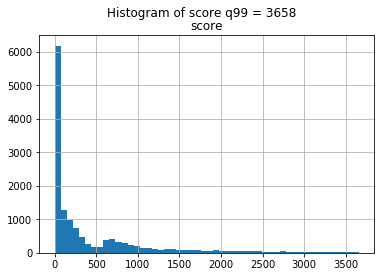
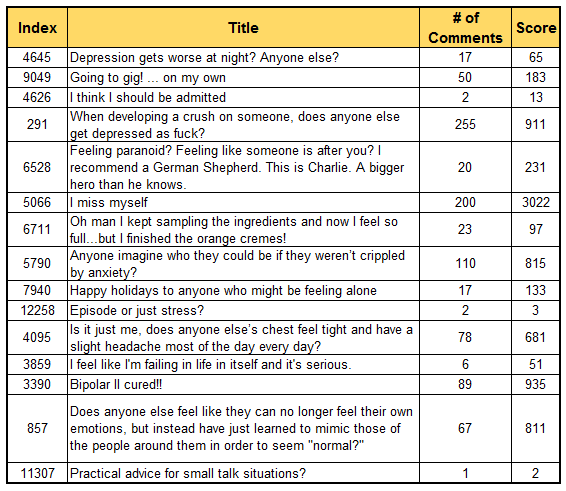
In this project, the analysis includes subreddit indicators in the neural network model predicting social supports for reddit posts. The figure below shows statistics for subreddit indicators for a sample dataset. It can be seen that the mean for the target variables is very different between subreddits.

Additional inputs include counts of frequent bigrams and emotion labelling of keywords. Emotion labelling was done through an NLP approach, using an already existing emotions lexicon.

Background:

ReferenceExplanationDataset/InputWeakness
Schrading, N. et al. [1]They trained and compared multiple classifiers on content of reddit posts to determine the top semantic and linguistic features in detecting abusive relationships. Subreddit posts with comments that focus on domestic abuse, plus subreddit posts with comments unrelated to domestic abuse as a control set.Future studies could be implemented on datasets from multiple websites to compare online abuse patterns across forums.
De Choudhury, M. & De, S. [2]They trained a negative binomial regression model on content of reddit posts (i.e., length, use of 1st pronoun, relationship words, emoticons, positive and negative words, etc.) to predict social support variables (karma points and number of responses).Posts, comments and associated metadatafrom several mental health subreddits, including alcoholism, anxiety, bipolarreddit, depression,mentalhealth, MMFB (Make Me Feel Better), socialanxiety, SuicideWatch.– Out of the top 15 discussed predicting variables used in the regression model, the highest coefficient have the intercept and the use of the 1st pronoun. – There is no discussion about correlations between predicting variables (for example, the study uses such variables as negative emotion, positive emotion and number of emoticons, which could be correlated).

Methodology

Schrading, N. et al. [1] reported that out of the post features they analyzed, ngrams were the most predicting ones when detecting abusive relationships in reddit posts. De Choudhury M. & De, S. [2] tried to predict social support variables for mental health related reddit posts using post length, emoticons, unigrams, variables built based on presence of emotionally charged unigrams, etc.

In this project, to predict social support variables (scores and number of comments) for mental health related reddit posts, the model was built using the neural networks approach and with emotionally charged unigrams as indicators of 10 different emotions, emotions count, post length, part of speech frequencies (counts of verbs, pronouns, adverbs and adjectives), count of first pronouns, number of question marks, post length, count of frequent bigrams, and subreddit indicators as predictive variables.

Below is the list of the input used in the models for predicting the score and number of comments:

‘anger’, ‘anticipation’, ‘disgust’, ‘fear’, ‘joy’, ‘negative’, ‘positive’, ‘sadness’, ‘surprise’, ‘trust’,’len_post’, ‘len_post_orig’, ‘first_pronoun_count’, ‘freq_bigram_count’, ‘q_count’, ‘verb_count’, ‘pronoun_count’,’adverb_count’, ‘adjective_count’, Subreddit(display_name=’BipolarReddit’), Subreddit(display_name=’Anxiety’), Subreddit(display_name=’depression’), Subreddit(display_name=’schizophrenia’), Subreddit(display_name=’bipolar’), Subreddit(display_name=’mentalhealth’), Subreddit(display_name=’depression_help’), Subreddit(display_name=’BPD’), Subreddit(display_name=’socialanxiety’), Subreddit(display_name=’mentalillness’)

Emotion lexicon

A public lexicon dataset was used to determine counts of specific emotion words. The NRC Emotion Lexicon is a list of English words and their associations with eight basic emotions (anger, fear, anticipation, trust, surprise, sadness, joy, and disgust) and two sentiments (negative and positive).

https://nrc.canada.ca/en/research-development/products-services/technical-advisory-services/sentiment-emotion-lexicons

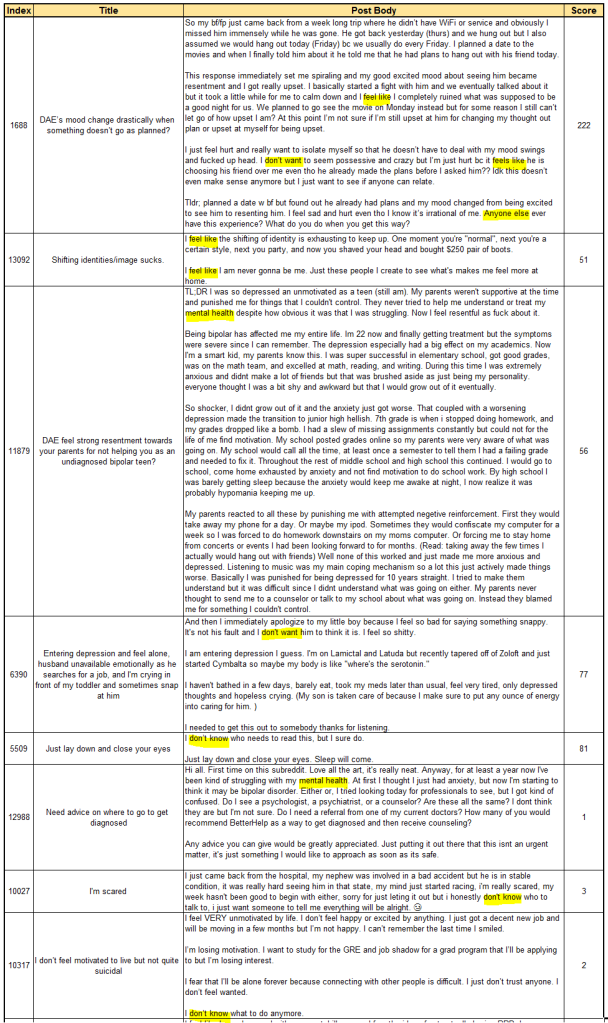
Below are examples of posts with most frequent bigrams highlighted. Frequent bigrams ‘feel like’, ‘feels like’ are consistent with the finding by De Choudhury M. & De, S. [2] of frequent unigrams related to emotional expression.

N-grams

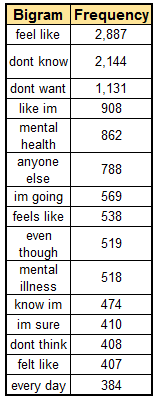
For this project we identified most popular bigrams and trigrams. The counts of most frequent bigrams and trigrams were used while testing various models, and the most useful data turned out to be counts of most frequent 16 bigrams, which were used as one of the inputs to the model.

Below is the list of the most popular bigrams used and a few examples of their usage in raw texts.


Implementation

Data Collection

Obtained data via a public API from 10 mental health subreddits: “depression”, “anxiety”, “bipolarreddit”, “mentalhealth”, “socialanxiety”, “depression_help”, “bipolar”, “BPD”, “schizophrenia”, and “mentalillness”.

  • First, checking 10 hot posts for each subreddit indicator
  • Collecting data

top_posts dimensions: (9949, 9)

hot_posts dimensions: (9890, 9)

new_posts dimensions: (9896, 9)


Preparing the Data

reddit data scraping is limited to a maximum of 1000 records per subreddit per each of 3 post categories (“hot”, “top” and “new” posts). To maximize the dataset size, we collected posts of all 3 categories and removed duplicate records that have categories overlapping. As mentioned by De Choudhury M. & De, S. [2], reddit posts reach most of their commentary within the first 3 days from being posted. Thus, we removed posts that were “younger” than 3 days old at the data collection time.

  • Removing stop words and punctuation
  • Created ngrams (bigrams, trigrams and fourgrams)
  • Applying smoothing for trigrams and removing extra words referring to posts, unrelated to this analysis (i.e., moderator’s posts)
  • Creating emotions dataframe, count POS (part of speech) tags, and topic/subreddit dummies

Reddit score prediction model – results based on first layer weights:
In a multi-layer neural network it is hard to interpret raw internal weights, but it looks like mental health-specific variables (such as indicators for fear or surprise, or subreddit indicators) are more important than generic (such as verb count or the length of the post, which looks to be least useful). In particular most subreddit indicators (“depression_help”, “depression”, “schizophrenia”, etc.), which were not used in other papers, are in top 10 for total weights.


Conclusion and Future Direction

In conclusion, neural network results showed that the model inputs do have some predictive power for social response variables ‘number of comments’ and ‘score’, as the sums of weights for input variables were found to be greater than zero. Also during model testing, starting with fewer input variables, adding the rest of the input variables reduced the absolute mean errors.

One of the future improvements for this analysis could be incorporating a variable that indicates whether the post is from a throwaway account or an existing long-term reddit account, as De Choudhury, M. & De, S. [2] mention that reddit’s throwaway accounts allow individuals to express themselves more honestly and to ‘discuss uninhibited feelings’.

Also, while content and length of post titles and how users action on posts (click, read, and reply) might have an impact on post’s score, neither of the research papers cited, nor this analysis used title analysis as a part of the model. As such adding title attributes and post actioning statistics variables to the model could be a potential area for improvement.


References:

[1]: Schrading, N., Alm, C. O., Ptucha, R., & Homan, C. M. An Analysis of Domestic Abuse Discourse on Reddit, The 2015 Conference of Empirical Methods in Natural Language Processing, Lisbon, Portugal, September 2015, pages 2577-2583.

[2]: De Choudhury, M. & De, S. Mental Health Discourse on reddit: Self-Disclosure, Social Support, and Anonymity. Eights International AAAI Conference on Weblogs and Social Media, North America, May 2014, pages 71-80. Available at: https://www.aaai.org/ocs/index.php/ICWSM/ICWSM14/paper/view/8075/8107.

[3] Mann, C. E. & Himelein, M. J. Factors Associated with Stigmatization of Persons with Mental Illness. Psychiatric Services, Vol. 55, No. 2., February 2004, pages 185-197. Available at: https://ps.psychiatryonline.org/doi/pdf/10.1176/appi.ps.55.2.185.

Developing a schedule for a healthier pregnancy

Pregnancy can be very difficult, especially if you already have chronic health problems. Personally, I felt very sick starting week three, and until around week 12 – 13. The sickness presented itself in terms of nausea, extreme fatigue, and increased anxiety. Only once I started to feel less nauseous, I was able to go back to my regular diet which limits refined carbs and continue with intermittent fasting again. I did then also start feeling worse in the third trimester, around after week 34. From my experience, these are the actions which have helped me to feel better:

  • Start taking folic acid as soon as possible, preferably before conception. Folic acid supplementation has been found to reduce neural tube defects, as well as congenital heart defects. Taking folic acid supplement every day can provide a positive feeling that you are doing the right thing for your baby’s health.
    From Health Canada: “Folic acid is vital to the normal growth of your baby’s spine, brain and skull. Taking a daily vitamin supplement that has folic acid can reduce the risk of your baby having a neural tube defect. The benefits of taking folic acid to reduce the risk of NTDs are highest in the very early weeks of pregnancy. At this stage, most women do not know they are pregnant. For this reason, taking folic acid before you become pregnant and in the early weeks of pregnancy is very important.”
    https://www.canada.ca/en/public-health/services/pregnancy/folic-acid.html
    Recent studies have shown that high folate intake is associated with a reduced risk of birth defects other than NTDs. Higher maternal folate or periconceptional use of folic acid is associated with a lower risk of congenital heart defects (20-23) and oral clefts (24). A recent meta-analysis of 1 randomized controlled trial, 1 cohort study, and 16 case-control studies has shown that maternal folate supplementation is associated with a lowered CHD risk (RR =0.72, 95% CI: 0.63–0.82) (25). However, the results showed considerable heterogeneity, but after excluding the outliers the risk estimate was almost unchanged: the corresponding pooled RRs were not materially altered (RR =0.78, 95% CI: 0.69–0.89) (25).
    https://www.ncbi.nlm.nih.gov/pmc/articles/PMC6837928/#:~:text=Recent%20studies%20have%20shown%20that,and%20oral%20clefts%20(24).
  • Iron supplements – Iron deficiency is the most common nutritional deficiency during pregnancy. It happens most often during the third trimester. The iron in meat, fish and poultry is the easiest for our bodies to absorb and use. Foods rich in vitamin C help you absorb more iron. You can start taking an iron supplement during pregnancy in order to make sure you get enough and to prevent anemia. Low iron can lead to more fatigue, shortness of breath, weakness, headache, dizziness. All these symptoms in turn can make you more depressed. If low iron will lead to anemia, there will not be enough hemoglobin, and less oxygen will get to your cells. Cells won’t be functioning properly, and this can also contribute to depression and anxiety.
  • Prenatal vitamins – you can easily buy prenatal vitamins in a pharmacy or online. Nutritional yeast flakes also contain multiple vitamins. I’ve experienced more and more lethargy in the third trimester, and I started adding small doses of nutritional yeast flakes to smoothies. I have the Bob’s Red Mill brand, it is fortified inactive yeast, contains high doses of B vitamins – thiamine, riboflavin, niacin, B6, folate, and B12. It’s very cheap, given that the whole pack was around $8, and I consume less than a teaspoon a day, as the vitamin concentration is very high. I don’t see the need to take more than the needed daily value of B vitamins. I found that actually taking overly high doses of B vitamins for me can lead to panic attacks. Small doses of nutritional yeast do help me with energy during the third trimester, it can get me out of a very lethargic vegetative state to at least being able to wash the dishes, write in my blog, etc.
  • Sleep more – pregnancy can cause extreme fatigue. I found that instead of 7 – 8 hours, I currently need to sleep 9 hours. It helped me to start going to bed earlier, before 12am, then I am able to wake up for work before 9am. I also found that staying asleep became more difficult, I would wake up at around 4:30am, unable to fall back asleep. What helped me is eating the last meal four hours before bed, and the meal consisting mostly of non-refined starch, and not a lot of protein. The best sleep occurs for me if I eat short grain brown rice or potatoes (not fries) with something for dinner. Some studies mention that it is the prebiotic foods which can help sleep. “More commonly eaten foods that contain prebiotics include asparagus, onions, garlic, cashews, pistachios, and cooked and cooled grains and potatoes.” On the other hand, I found that eating cheese or red meat in the evening causes nightmares for me during the night, therefore I only eat those foods earlier on in the day.
    https://www.sbs.com.au/food/article/2020/03/13/science-suggests-prebiotic-foods-might-help-you-sleep
  • Foods for anxiety – even though there is no recommendation to completely avoid coffee during pregnancy, I had to stop drinking any coffee as it would increase my anxiety more than before pregnancy. I also had to figure out which foods exacerbate acid reflux, which got worse. Ongoing acid reflux would make it uncomfortable for me to sit, lie down, sleep, and relax. It’s hard to calm down and do any breathing exercises, or just read a book, if your throat is burning, and you feel acid going up. I had to stop eating chocolate, spicy foods, coffee, black tea, lemon, soups, and meals containing a lot of tomatoes. I found oolong tea to be a good option. I also found helpful choosing complex carbs over refined carbs – making my own oat whole wheat pancakes, eating brown rice, potatoes, lentil pasta, plantains. Eat some protein with each meal.
    From the Mayo Clinic: “Carbohydrates are thought to increase the amount of serotonin in your brain, which has a calming effect. Eat foods rich in complex carbohydrates, such as whole grains — for example, oatmeal, quinoa, whole-grain breads and whole-grain cereals. Steer clear of foods that contain simple carbohydrates, such as sugary foods and drinks.
    I also had to stop consuming all dairy products, I noticed they were making my anxiety worse, as well as increasing brain fog. Again, from the Mayo Clinic:
    Pay attention to food sensitivities. In some people, certain foods or food additives can cause unpleasant physical reactions. In certain people, these physical reactions may lead to shifts in mood, including irritability or anxiety.
  • Food sensitivities – if you are avoiding any foods due to food sensitivities, make sure you get enough nutrients from other foods. I used to eat dark chocolate, which contains a lot of magnesium, but had to stop due to acid reflux. I made sure to eat other magnesium containing foods such as peanuts, bananas, and flax seeds. I also had to stop consuming any dairy, as I noticed that it was increasing my anxiety, rumination, and brain fog. I had to start consuming fortified soy milk, tofu, dairy-free yogurts, etc., in order to get calcium. I also took calcium supplements, and made my own supplement from egg shells.
  • Exercise – an important step with exercise, as with all pregnancy symptoms/issues in general, for me was acceptance. Acceptance that I could no longer do what I used to do several weeks ago. I used to dance for my mental health, because I enjoy reggaetón, and moving freely, and aerobic exercise is supposed to reduce depressive symptoms. I had to accept that I could no longer do that on most of the days due to nausea, fatigue, migraines. But still when I could, I tried to move – going for a walk near my house, going up and down the stairs (the house where I live has a staircase), doing a physical chose – washing the floor, vacuuming. Some movement is better than no movement at all, and I accepted that is it the situation right now, but it is also temporary.
  • Mindfulness – sometimes you cannot solve a problem. I have been feeling pretty lethargic throughout the whole pregnancy, especially in the third trimester. I was also not able to resolve the acid reflux issue and the stuffy nose, only reduce the symptoms somewhat. Mindfulness helps to observe your experiences from the side and accept that these are the current sensations/emotions/symptoms. I think observation can help realize how negative symptoms come in waves, so that you don’t end up generalizing or catastrophizing – “every day is terrible”, “I always feel awful”. I’m also mindful of the fact that I chose to be pregnant, as my goal is to have my own family, therefore this is something I have to go though in order to achieve my goal. I also remind myself that pregnancy is definitely a temporary condition, no one has stayed permanently pregnant.

Improvement with lithium chloride supplement

I have extensive experience with psych meds, first prescription being abilify and seroquel in 2015, then mirtazapine, wellbutrin, risperidone, cymbalta, trazodone, and more. None of the meds worked for me. Last trial was of fluoxetine in November, which caused severe insomnia on only 10mg, and panic attacks. In March I also tried Zembrin which is a serotonin reuptake inhibitor (SRI). Zembrin also caused panic attacks for me and increased psychotic symptoms. I decided I don’t want to touch any additional SSRIs, SNRIs, nor SRIs.

I have also tried shrooms microdosing. I found that 1-4 gram occasional trips are better for me as microdosing makes me fatigued. While on shrooms though, a lot of thoughts came to me about reducing my caffeine intake and lithium. Lithium was mentioned to me several years ago by one consulting psychiatrist, but was never prescribed. I asked my current psych about it, but she refused to prescribe it.

While I was on Zembrin in March, by mid-month I started to get more paranoid and psychotic, as I was also in luteal phase of my cycle. A lot of women with mental illness experience PME – premenstrual exacerbation of symptoms. I unfortunately experience that as well. Mid-March I decided to stop Zembrin and any other supplements I was trying – mushroom coffee, rhodiola rosea, St. John’s Wort tea. I also stopped drinking coffee in general as I think it exacerbates my mood swings. I only continued with lithium orotate supplement that I purchased, but I stopped it as well as it seemed that it was causing more frequent urination. As I stopped these supplements and my period stabilized, my mental state somewhat stabilized to a point where I could better observe myself and think about what to do next. I decided that I still wanted to try lithium, but purchased a supplement which was in a different form – liquid which contains lithium chloride, instead of the lithium orotate tablets. I chose lithium chloride because there is more existing research on it than on lithium orotate. I also made homemade CBD oil from the Avidekel strain.

Well it has been over two months since mid-March and I’ve hard a lot more days which were just ‘alright’ instead of being a struggle with intrusive thoughts and depression. I’ve felt more calm and was able to read more throughout these two months, actually finished two books, on my third now. So in general a beneficial experience so far, will see how it goes.

Great psychiatry podcast. Impresionante podcast de psiquiatría.

Just wanted to post a link to a very interesting psychiatry podcast. For now I have specifically listened to the interviews with Dr. Cummings and I really enjoyed all the episodes. Dr. Cummings seems to be a very knowledgeable psychiatrist and provides a lot of information about areas of the brain, neurotransmitters, psychopharmacology. Currently I drive to work and back on a daily basis and I have been listening to the episodes in the car.

PSYCHIATRY & PSYCHOTHERAPY PODCAST

*************************************************************************************

Solo quería publicar un enlace a un podcast de psiquiatría muy interesante. Por ahora he escuchado específicamente las entrevistas con el Dr. Cummings y realmente disfruté todos los episodios. El Dr. Cummings parece ser un psiquiatra muy conocedor y comparte mucha información sobre áreas del cerebro, neurotransmisores, psicofarmacología. Actualmente conduzco diariamente al trabajo y de regreso y he estado escuchando los episodios en el auto.

1 gram of shrooms helped me realize that I have a caffeine addiction which negatively impacts my BPD symptoms

I recently did 1 gram of shrooms and even though it was not such a dose that I would see any visuals, it was a very useful experience for me.

I have been diagnosed with having borderline personality disorder traits, which then lead to depression and anxiety.

Caffeine definitely is not the cause of my BPD symptoms, but the recent shrooms experience helped me realize that I do have a caffeine addiction which negatively impacts my life. I think I have been denying it, saying to my self that – it’s just caffeine, it’s not like I do illegal stimulant drugs. Shrooms helped me accept that brain biochemistry doesn’t care about the legal status of caffeine. I had to accept that even though being completely legal and sold everywhere, I do get mood crashes from caffeine as I would from cocaine (which I tried a long time ago in high school). I can have a few cups of tea in a day, but I do like to drink several in a row, I also like coffee and yerba mate. I have been observing my symptoms for a while and I do notice that I get dysphoric later on in the day if I have coffee or yerba mate in the morning, especially on an empty stomach. I also get more paranoid about being alone, not having any friends (even though I do have several good friends), etc. I knew this for a while, just shrooms helped me accept that I really should do something about the caffeine addiction as it really negatively impacts my mood and sense of self.

I don’t think I need to completely give up tea, but I did have to quit coffee and yerba mate, which actually did help me to have a more even mood throughout the day. I also have been taking CBD oil that I made at home, I think that also helps with anxiety and mood swings. I will still have a few cups of black tea, which I love, but I need to limit myself at only three-four cups of tea per day, not very strong.

This realization might seem not very important, maybe some people expect some enlightenment or spiritual experiences from shrooms, but whenever I do shrooms I actually feel very logical and I am able to see myself from a side. I was able to analyze the correlation between my caffeine consumption and my BPD symptoms in a more unbiased way and this is actually an important realization for me, as BPD symptoms really worsen my quality of life, so if something like reducing caffeine can help – it’s not a breakthrough for humanity, but a big improvement for me. And also hoping to help anyone else reading it affected by BPD – I do believe caffeine might worsen psychiatric symptoms for some individuals.

Beautiful schizophrenia treatment success story

I found Quentin’s successful outcome in this story very hopeful. I don’t have schizophrenia, antipsychotics did not turn out to be useful for me, but it’s great to hear how they do work for many people with schizophrenia and how the outcomes can now be so different in comparison to the times before invention of antipsychotics. My psychosis has also mostly subsided since the treatment of encephalitis with intravenous steroids, prednisone, and intravenous immunoglobulin. I do have issues remaining with depression, but definitely the psychosis is maybe at the 5% level of what is used to be, and many times of the day no psychosis is currently present at all for me. Sometimes I even have thoughts – hey, maybe it wasn’t that bad, was I really that psychotic? Maybe I am exaggerating my story? But then I look back and yes, it was terrible, it was hell.

If you listen to Quentin’s story, I had actually very similar symptoms as he describes – I had persistent thoughts that my boyfriend and my parents were in danger and that only I had to protect them with my thoughts. Then also came the idea that me being anxious about their safety is increasing the danger, so they would be safer if I didn’t exist, because it was my thoughts that were putting them in danger. And these ideas were not occasional, they were persisting every second of the day. It’s easy to realize that it’s not possible to function or have any desire to live that way, especially if you are convinced that by being alive you are putting very close people to you in danger. I don’t really want to imagine what would happen to me if I didn’t figure out that I had encephalitis and wouldn’t get the immunosuppressant treatment, or what would happen to young people like Quentin before the invention of antipsychotics. I’m glad that his treatment story is a very positive one and that currently he is doing really well, studying for his engineering degree, doing an internship at a lab, and finding interest in life.

AFTER WINTER : A Real Life Schizophrenia Treatment Story


Observations on calcium and PMS/PMDD symptoms. Observaciónes sobre calcio y síntomas de SPM/TDPM.

After several visits to the doctor, I finally received references for hormone blood tests. I definitely do not regret spending time on doctor visits and laboratory tests, because it was really interesting to observe hormonal fluctuations throughout the cycle. The results clearly showed that my progesterone level quickly rises during the luteal phase, close to 50 nmol/l. One day/several days before menstruation, my progesterone drops to 1.8 nmol / l. At the peak, my progesterone was close to the top threshold. The level was not exactly abnormal, but research indicates that some women react negatively to changes in hormone levels.

Premenstrual dysphoric disorder (PMDD)  – a much more severe form of premenstrual syndrome (PMS). It may affect women of childbearing age. The exact cause of PMDD is not known. It may be an abnormal reaction to normal hormone changes that happen with each menstrual cycle. The hormone changes can cause a serotonin deficiency.

What is premenstrual dysphoric disorder (PMDD)?

I also came across an article in the Journal of Clinical Endocrinology & Metabolism, which states that there may be cyclical changes in calcium metabolism during the menstrual cycle in women with PMDD. Interesting points from the article:

  • Irritability, anxiety, and mania have been associated with hypocalcemia, whereas increased calcium concentrations have been noted in some patients with depression.
  • Three separate investigations have demonstrated that the dysphoria, anxiety, depression, and somatic symptoms of PMS all respond favorably to either increased dietary calcium intake or daily calcium supplementation
  • Increased calcium intake proved to benefit significantly all four major categories of PMS symptoms (negative affective symptoms, water retention symptoms, food cravings, and pain symptoms).
  • When compared with asymptomatic women, women with PMS were shown to have exaggerated fluctuations of the calcium-regulating hormones across the menstrual cycle with evidence of vitamin D deficiency and secondary hyperparathyroidism.

For the authors’ study – a total of 129 women completed the timed biochemical and hormone evaluation with 115 (68 PMDD and 47 controls) providing hormone data meeting criteria for analysis. Results – Although the screening baseline 24-h urine calcium was not found to be significantly different between the groups, the random urine calcium collections during hormonal sampling were significantly lower in the PMDD group compared with controls.

In the PMDD group, total serum calcium was found to be significantly lower at 3 points: at follicular phase 1 (menses) (9.17 ± 0.55 mg/dl, P < 0.001) compared with later phases 2, 3, and 4; at midcycle phase 3 (9.25 ± 0.55 mg/dl) compared with phase 2 (9.33 ± 0.58 mg/dl, P = 0.036); and during late luteal phase 5 (9.18 ± 0.73 mg/dl) compared with phase 4 (9.27 ± 0.55 mg/dl, P = 0.018). Ionized calcium did not fluctuate as dramatically as did total calcium, but a large difference was noted between early phases 1 and 2 of the menstrual cycle again with phase 1 having the lowest ionized calcium concentration (1.166 ± 0.072 vs. 1.175 ± 0.073 mmol/liter, P = 0.069). Intact PTH peaked in follicular phase 2 (56.9 ± 35.3 pg/ml) following the decline in serum calcium during phases 1 and 5. Follicular phase intact PTH was significantly higher than luteal phase concentrations and reached its nadir in luteal phase 4 (50.9 ± 34.4 pg/ml, P < 0.01). In conjunction with the follicular phase rise in intact PTH, serum pH was lower in the follicular phase 1 and 2 compared with midcycle phase 3 and luteal phase 4 (phase 1, 7.36 ± 0.004 vs. phase 3, 7.37 ± 0.023; P = 0.015; data not shown). The concentration of 1,25(OH)2D declined precipitously in luteal phase 4 and was significantly lower compared with all earlier phases (phase 4, 45.0 ± 27.5 vs. phase 3, 49.6 ± 27.5 pg/ml; P = 0.006). Urine calcium and 25OHD concentrations did not appear to vary between individual phases in the PMDD group.

Cyclical Changes in Calcium Metabolism across the Menstrual Cycle in Women with Premenstrual Dysphoric Disorder


*************************************************************************************

Después varias visitas al doctor, finalmente recibí referencias para análisis de sangre de hormonas. Definitivamente no me arrepiento de pasar tiempo en las visitas al médico y las pruebas de laboratorio, porque fue realmente interesante observar las fluctuaciones hormonales a lo largo de ciclo. Los resultados mostraron claramente que mi nivel de progesterona sube rápidamente durante la fase lútea, cerca de 50 nmol / l. Un día/ varios días antes la menstruacion, mi progesterona baja a 1.8 nmol / l. En el pico, mi progesterona estaba cerca del umbral superior. El nivel no era exactamente anormal, pero la investigación indica que algunas mujeres reaccionan negativamente a los cambios en los niveles hormonales.

Trastorno disfórico premenstrual (TDPM): una forma mucho más grave de síndrome premenstrual (SPM). Puede afectar a mujeres en edad fértil. La causa exacta de TDPM no se conoce. Puede ser una reacción anormal a los cambios hormonales normales que ocurren con cada ciclo menstrual. Los cambios hormonales pueden causar una deficiencia de serotonina.

También me encontré con un artículo en el Journal of Clinical Endocrinology & Metabolism, que establece que puede haber cambios cíclicos en el metabolismo del calcio durante el ciclo menstrual en mujeres con TDPM. Puntos interesantes del artículo:

  • La irritabilidad, la ansiedad y la manía se han asociado con hipocalcemia, mientras que se han observado concentraciones elevadas de calcio en algunos pacientes con depresión.
  • Tres investigaciones separadas han demostrado que la disforia, la ansiedad, la depresión y los síntomas somáticos del síndrome premenstrual responden favorablemente al aumento de la ingesta de calcio en la dieta o a la suplementación diaria de calcio.
  • El aumento de la ingesta de calcio demostró beneficiar significativamente las cuatro categorías principales de síntomas de SPM (síntomas afectivos negativos, síntomas de retención de agua, antojos de alimentos y síntomas de dolor).
  • En comparación con las mujeres asintomáticas, las mujeres con síndrome premenstrual mostraron fluctuaciones exageradas de las hormonas reguladoras de calcio a lo largo del ciclo menstrual con evidencia de deficiencia de vitamina D e hiperparatiroidismo secundario.

Para el estudio de los autores, un total de 129 mujeres completaron la evaluación bioquímica y hormonal cronometrada con 115 (68 TDPM y 47 controles) que proporcionaron datos hormonales que cumplían los criterios para el análisis. Resultados: aunque no se encontró que el calcio basal en orina de 24 h para la detección sea significativamente diferente entre los grupos, las recolecciones aleatorias de calcio en orina durante el muestreo hormonal fueron significativamente más bajas en el grupo TDPM en comparación con los controles.

En el grupo TDPM, se encontró que el calcio sérico total era significativamente más bajo en 3 puntos: en la fase folicular 1 (menstruación) (9.17 ± 0.55 mg / dl, P <0.001) en comparación con las fases posteriores 2, 3 y 4; en la fase 3 del ciclo medio (9,25 ± 0,55 mg / dl) en comparación con la fase 2 (9,33 ± 0,58 mg / dl, P = 0,036); y durante la fase lútea tardía 5 (9,18 ± 0,73 mg / dl) en comparación con la fase 4 (9,27 ± 0,55 mg / dl, P = 0,018). El calcio ionizado no fluctuó tan dramáticamente como el calcio total, pero se observó una gran diferencia entre las fases tempranas 1 y 2 del ciclo menstrual nuevamente con la fase 1 con la concentración más baja de calcio ionizado (1.166 ± 0.072 vs. 1.175 ± 0.073 mmol / litro , P = 0,069). La PTH intacta alcanzó su punto máximo en la fase folicular 2 (56,9 ± 35,3 pg / ml) después de la disminución del calcio sérico durante las fases 1 y 5. La PTH intacta en la fase folicular fue significativamente mayor que las concentraciones de la fase lútea y alcanzó su punto más bajo en la fase lútea 4 (50,9 ± 34,4 pg / ml, P <0,01). Junto con el aumento de la fase folicular en la PTH intacta, el pH sérico fue menor en la fase folicular 1 y 2 en comparación con la fase 3 del ciclo medio y la fase lútea 4 (fase 1, 7.36 ± 0.004 vs. fase 3, 7.37 ± 0.023; P = 0.015 ; datos no mostrados). La concentración de 1,25 (OH) 2D disminuyó precipitadamente en la fase lútea 4 y fue significativamente menor en comparación con todas las fases anteriores (fase 4, 45.0 ± 27.5 vs. fase 3, 49.6 ± 27.5 pg / ml; P = 0.006). Las concentraciones de calcio en la orina y 25OHD no parecen variar entre las fases individuales en el grupo TDPM.

Vitamins before antidepressants . Vitaminas antes de los antidepresivos.

Texto en español a continuación.

This post will not be against antidepressants. I only want to share my experiences, in case they might help someone. I found out the hard way that eating healthy and obtaining all the basic vitamins is necessary (but not sufficient) for mood stability and emotional regulation. Unfortunately not all doctors or psychiatrists check for vitamin and mineral deficiencies before prescribing antidepressants. There is a lot of research indicating that many vitamins and minerals are important for the functioning of neurotransmitters. So I am not stating ‘always vitamins instead of antidepressant’, but in my opinion as a patient, diet should always be reviewed first. Especially if you have any gastrointestinal problems, family history of gastrointestinal issues, or you live in a northern country. Also if you are vegan, vegetarian, or have any other food restrictions.

I have written in my previous posts about getting a diagnosis of autoimmune encephalitis, but let’s set that aside for now. I did end up being referred to a neurologist, but in this post I want to focus on my experience with psychiatrists. When I was referred to a psychiatrist by the emergency department, several blood tests were performed. Blood glucose level, iron level, thyroid stimulating hormone (TSH) test results were sent to the psychiatrist. Since these test results came back normal, right away the psychiatrist prescribed me mirtazapine.

Mirtazapine did not help my mood and I only gained weight on it and had trouble waking up in the morning. Therefore, my dissatisfaction with this approach is that several important blood tests were not prescribed. For example, I live in a northern country, therefore it is possible to be deficient in vitamin D. They also didn’t ask me about my diet, but a spicy diet can lead to deficiencies in B vitamins and omega 3 fatty acids. Additional point – my blood glucose was checked only once, it was not proven how I react to eating carbohydrates.

Later I discovered that I was deficient in vitamin D, that my blood sugar level would jump too high after eating refined carbohydrates, and I was not getting enough folic acid and calcium. By not performing the necessary laboratory tests, the doctor lost a lot of time and delayed my treatment. I was also taking unnecessary high doses of antidepressants, which were not helping.

*************************************************************************************

Esta publicación no será contra los antidepresivos. Solo quiero compartir mis experiencias, en caso de que puedan ayudar a alguien. Descubrí por las malas que comer sano y obtener todas las vitaminas básicas es necesario (pero no suficiente) para la estabilidad del estado de ánimo y la regulación emocional. Desafortunadamente, no todos los médicos o psiquiatras verifican las deficiencias de vitaminas y minerales antes de recetar antidepresivos. Hay mucha investigación que indica que muchas vitaminas y minerales son importantes para el funcionamiento de los neurotransmisores. Por lo tanto, no estoy diciendo “siempre vitaminas en lugar de antidepresivos”, pero en mi opinión como paciente, la dieta siempre debe revisarse primero. Especialmente si tiene problemas gastrointestinales, antecedentes familiares de problemas gastrointestinales o si vive en un país del norte. Además, si eres vegano, vegetariano o tienes otras restricciones alimenticias.

He escrito en mis publicaciones anteriores sobre el diagnóstico de encefalitis autoinmune, pero dejemos eso de lado por ahora. Terminé siendo referido a un neurólogo, pero en esta publicación quiero centrarme en mi experiencia con los psiquiatras. Cuando el departamento de emergencias me remitió a un psiquiatra, me realizaron varios análisis de sangre. Los resultados de las pruebas de nivel de glucosa en sangre, nivel de hierro y hormona estimulante de la tiroides (TSH) se enviaron al psiquiatra. Como los resultados de estas pruebas mostraron ser normales, de inmediato el psiquiatra me recetó mirtazapina.

Mirtazapine no ayudó mi humor y solo subí de peso, y tuve dificultad para despertar en las mañanas. Entonces, mi insatisfacción con este enfoque está que varios análisis de sangre importantes no fueron prescritas. Por example, vivo en un país del norte, por lo tanto está posible estar deficiente en vitamina D. También no me preguntaron sobre mi dieta, pero una dieta espicifica puede conducir a las deficiencias en vitaminas B y ácidos grasos omega 3.  Punto adicional – mi glucemia se comprobó solo una vez, no fue probado cómo reacciono al comer carbohidratos.

Mas tarde descubrí que era deficiente en vitamina D, que mi nivel de azúcar en la sangre saltaria demasiado alto después de comer carbohidratos refinados, además no estaba recibiendo suficiente ácido fólico y calcio. Al no realizar las pruebas de laboratorio necesarias, el doctor perdió mucho tiempo y retrasó mi tratamiento. Además estaba tomando dosis altas innecesarias de antidepresivos, que no estaban ayudando.