Valley View Park Click to open side panel for more information is located on the southeast side of Bayview Avenue and Highway 407 in Markham. A trail runs right through the wooded ravine along German Mills Creek, a historic waterway named after William Berczy’s 1794 pioneer settlement. Berczy brought dozens of German families to Upper Canada, where they established Markham’s first industrial hub along the creek with grist, saw, and woollen mills. Just downriver, another local park called German Mills Settlers Park commemorates this original settlement and its pioneer heritage. Aside from the background highway noise, walking through the woods feels like you are completely out of the city. It is a very nice trail that lets you walk along both sides of the creek, with a few spots where you can cross over on the rocks.

The first mushroom I came across was growing in overlapping clusters on a tree stump, identified as Turkey Tail (Trametes versicolor). Its thin, fan-shaped caps display distinct concentric bands of brown, tan, and grey, trimmed with bright white edges. It is classified as a saprotrophic polypore, meaning it is a bracket mushroom that feeds on dead organic matter and releases spores through microscopic pores instead of gills. Because of this, it grows specifically on dead wood like tree stumps rather than directly in the soil, using specialized enzymes to break down tough wood fibers like lignin and cellulose to recycle those nutrients back into the forest. While it is non-toxic, Turkey Tail is not considered edible in the culinary sense because its tough, leathery texture makes it unpalatable, though it is often dried and brewed into teas or extracts.

Along the sides of the trail, I saw a lot of Crown Vetch (Securigera varia) growing low to the ground in the sunny spots. It is a perennial plant, meaning it comes back year after year. It stays quite short because its weak, trailing stems sprawl outward into thick mats rather than growing upward. There were large patches blooming along the path, with probably more than 50 pink flowers in total. Each round, crown-like cluster holds a group of tiny pink-and-white pea-shaped blossoms that stand out against the green leaves. It requires full sunlight and adapts well to both dry and moist soil, though it cannot tolerate standing water.
It reproduces both by seed and vegetatively. The flowers produce narrow, finger-like seed pods that split open to drop seeds, which can remain dormant and viable in the soil for several years. Even more aggressively, it spreads underground through a network of creeping roots (rhizomes) that send up new shoots, allowing a single plant to rapidly colonize an entire area. While it was originally brought over from Europe and Asia for erosion control on slopes, this fast underground spread lets it choke out local plants, making it an invasive species here in Ontario.
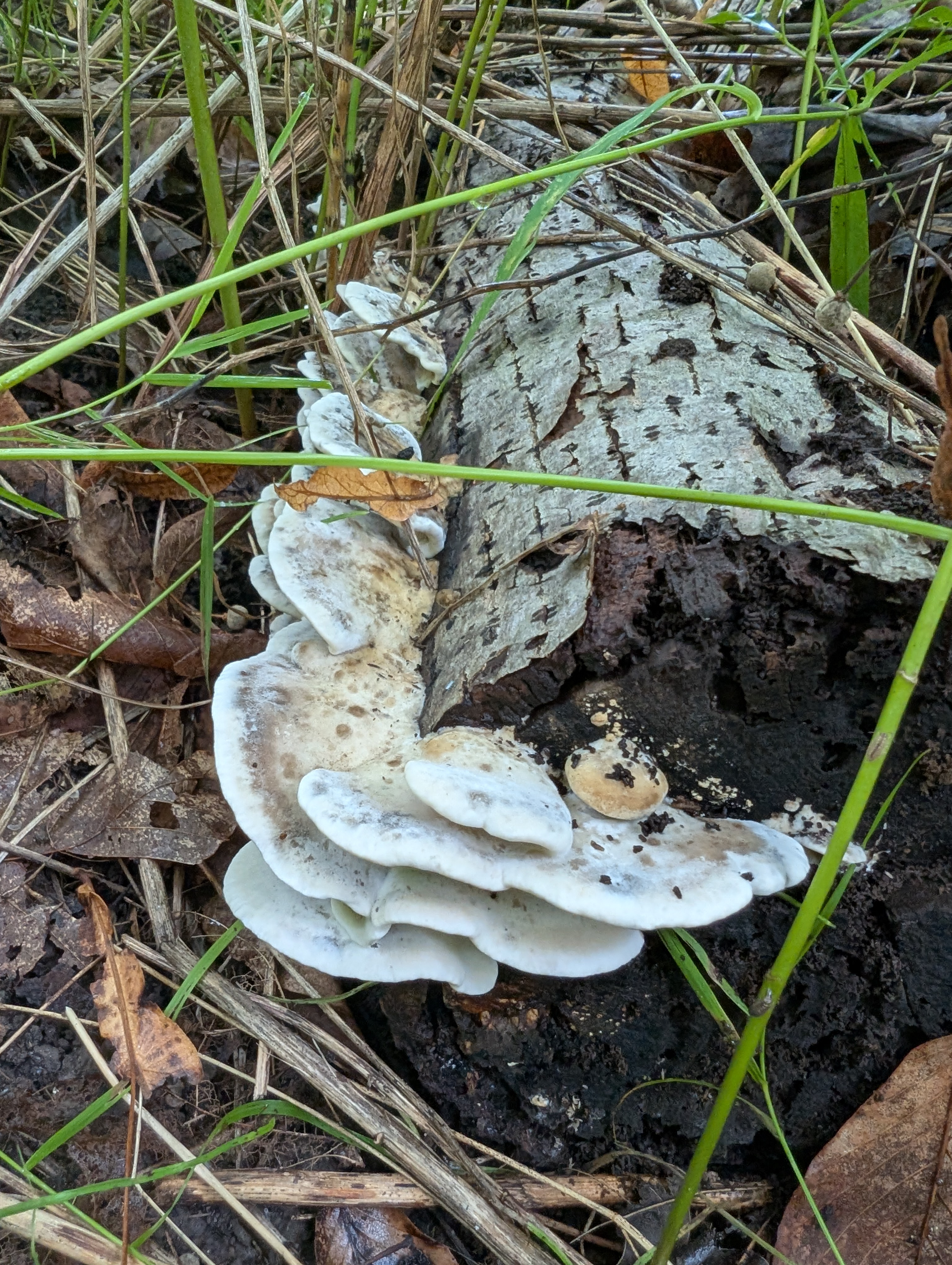
Further down the trail on a fallen log, I spotted another bracket fungus. It looks different from the Turkey Tail because it is noticeably thicker, more white with no grey, and has some brown spots on top. This is likely the White Cheese Polypore (Tyromyces chioneus). It reproduces similarly to Turkey Tail by releasing microscopic spores from tiny pores on its underside rather than gills. However, while Turkey Tail forms durable, leathery brackets that last for many months, the White Cheese Polypore produces a soft, annual fruiting body that rots away after a single season. It is a saprotrophic fungus that feeds on dead hardwood logs, using its white-rot capabilities to break down dense wood fibers and return essential nutrients back to the forest soil. While non-toxic, it is considered inedible due to its dense texture.
I’m glad that we have such nature exploring available so close to home!

