Ghost Pipe or Indian Pipe or Monotropa uniflora – it is a non-photosynthetic flowering plant. It’s neither a fungus nor a typical flower in terms of how it obtains its food, making it a particularly intriguing member of the plant world. It can be found in various parts of North America, from Alaska to California in the west and from Nova Scotia to Florida in the east. It also grows in parts of Asia, such as in the Himalayas and northeastern Siberia. It prefers shaded, moist, mature forests, especially those with abundant leaf litter and decaying organic matter, which supports the mycorrhizal fungi it relies on. The plant often grows under broadleaf trees like oaks and pines, benefiting from the fungi that form mutualistic relationships with these trees.
An individual Indian pipe plant is ephemeral in nature. After it emerges from the ground, it flowers, sets seed, and then decays over a relatively short period, often within a week or two. The perennial part of the plant, its underground structures (like rhizomes), can live for several years. These structures can give rise to above-ground shoots annually for many years, under suitable conditions.
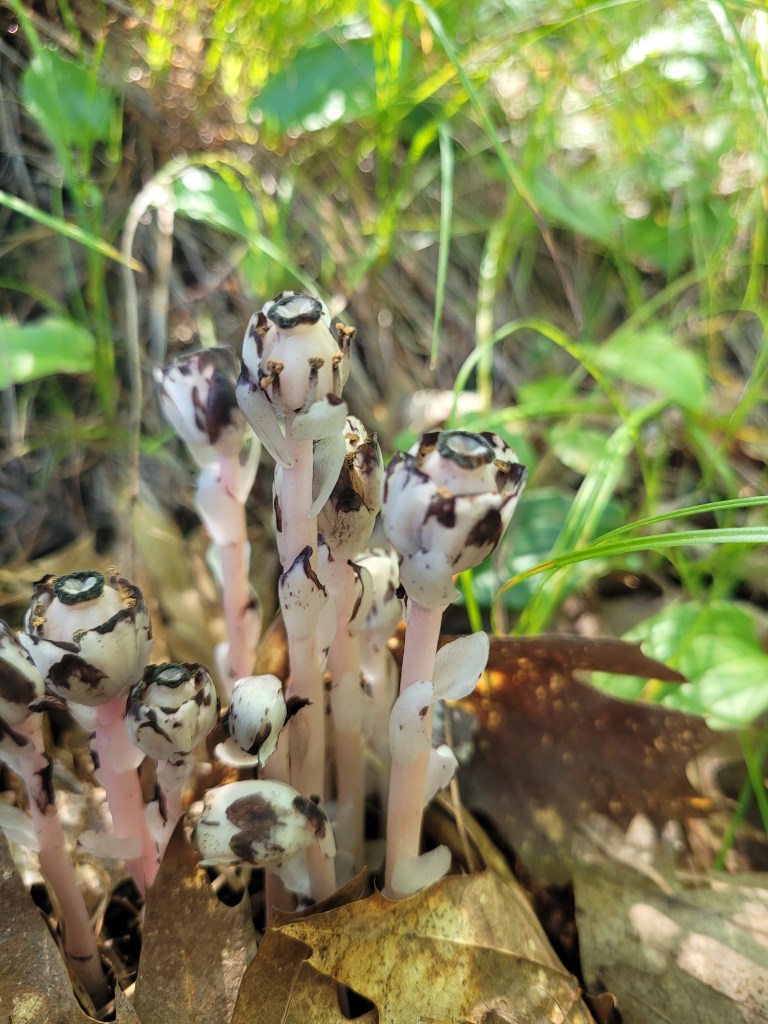
The photo below was taken by me recently this August. This Ghost Pipe was found in the beautiful Meisel Woods Conservation Area, Ontario, Canada.
More fun facts about the Ghost Pipe:
- Lacks Chlorophyll: Unlike most plants, Monotropa uniflora lacks chlorophyll, the green pigment that enables photosynthesis. This absence gives it its distinctive pale or translucent appearance.
- Mycotrophic Nutrition: Since it can’t produce its own food through photosynthesis, Monotropa uniflora obtains its nutrients through a unique relationship with mycorrhizal fungi. These fungi have a mutualistic relationship with certain trees, exchanging nutrients with them. So, indirectly, Monotropa uniflora is obtaining nutrients from the trees via the fungi. In essence, it “eats” by parasitizing the fungi that are associated with tree roots.
- Fungi Partners: The primary group of fungi that associate with Monotropa uniflora are from the Russulaceae family. This includes fungi that are ectomycorrhizal with trees, forming a sheath around tree roots where nutrient exchange occurs.
- Reproduction: It’s a flowering plant, so it reproduces via seeds. The flowers are typically pollinated by bees. After pollination, the flower stands erect from its previously nodding position. The seeds of Monotropa uniflora contain very little energy reserve, so they require the presence of the right fungus to germinate. Once a seed comes into contact with a compatible fungus, the fungus will invade the seed and initiate the growth of the plant.
- Indirect Relationship with Trees: The ectomycorrhizal fungi have a symbiotic relationship with trees. In this mutualistic relationship:
– Trees provide the fungi with sugars produced through photosynthesis.
– The fungi provide trees with essential minerals and water from the soil.
– Monotropa uniflora exploits this system by drawing nutrients from the fungi, which indirectly means it’s obtaining resources from the trees, although it doesn’t directly parasitize the trees themselves. - Dependence on the Fungi-Tree Relationship: It’s essential to understand that without the fungi-tree relationship, Monotropa uniflora couldn’t survive. The plant is entirely dependent on the organic compounds produced by photosynthetic plants (trees) and transferred through the mycorrhizal fungi.
So the Ghost Pipe seems to be a parasitic plant! Do fungi benefit in any way from the plant?
In the relationship between Monotropa uniflora the fungi it associates with, it might seem that the fungi get the short end of the stick since the Indian pipe is effectively parasitizing the fungus. However, when looking at this association in the broader context of the forest ecosystem, some potential indirect benefits or considerations arise:
Seed Germination and Fungal Propagation: The initial interaction between the fungi and the Indian pipe seeds can promote fungal colonization. The process of seed germination and growth might offer conditions conducive for the fungal hyphae to spread and grow.
Promotion of Fungal Diversity: Interactions with plants like Monotropa uniflora might play a role in promoting fungal diversity in forest ecosystems. A diverse mycorrhizal network can enhance soil health and overall forest resilience.
 Notes of a Neuropsychiatry Amateur