Common haircap moss is also known as Polytrichum commune. This moss is often found in Ontario forests, and I find it very beautiful because it looks like miniature pine trees. This particular photo below I took in the Sheffield Conservation Area. Common haircap moss has tall and upright stems, so it looks quite different from most other moss types.
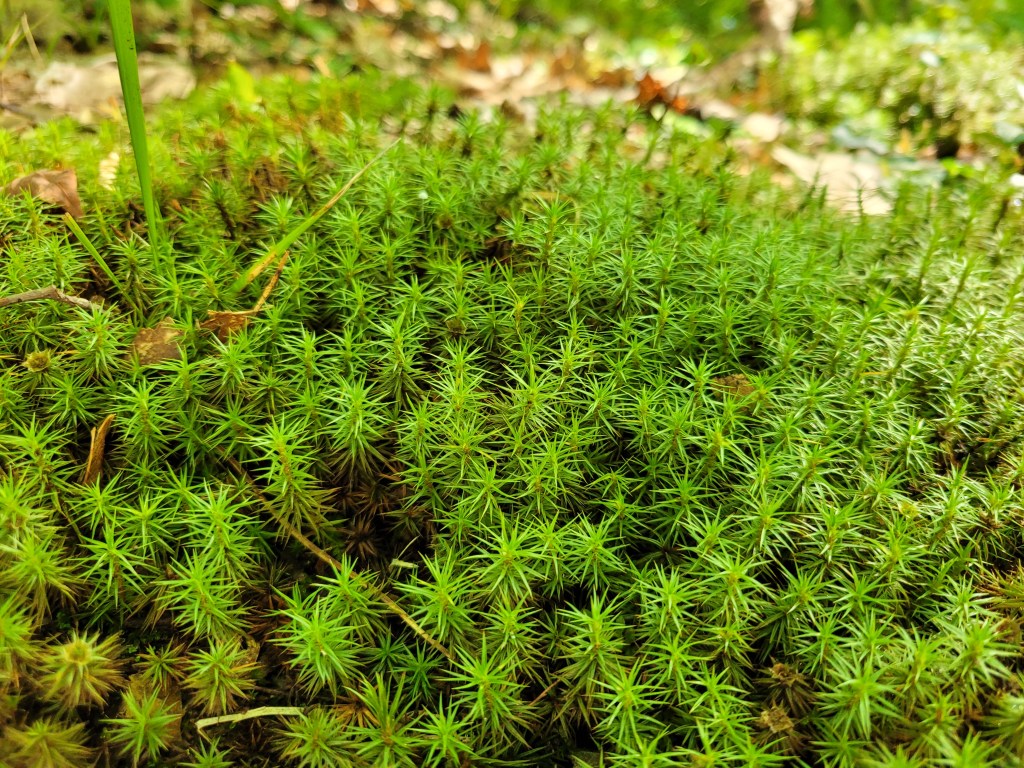
Common haircap moss is one of most widespread mosses, found on all continents, including Antarctica. It can thrive in a variety of habitats, from acidic bogs to well-drained sandy soils. Like other mosses, common haircap moss reproduces via spores rather than seeds. These spores are released from capsules that rise high above the leafy stems. Mosses, including the common haircap moss, have a unique and complex life cycle that involves alternating between two generations: the gametophyte and the sporophyte. Mosses reproduce using spores that form in capsules on the sporophyte generation. When mature, these capsules release spores into the environment. Upon landing in suitable conditions, the spores germinate and grow into the gametophyte generation, which is the leafy structure commonly recognized as moss. These leafy structures produce male and female reproductive organs. When conditions are moist, the male organs release sperm that swims to fertilize the eggs in the female organs. After fertilization, a new sporophyte grows from the gametophyte. This sporophyte matures and produces a capsule filled with spores.
So Mosses don’t require pollination in the same way that flowering plants do! Mosses depend on water for fertilization. The male structures release sperm only when the conditions are moist enough. Mosses can often fertilize themselves if both male and female reproductive structures are present on the same plant. However, cross-fertilization between different plants can also occur, especially in dioicous species where individual plants are either male or female.
The leaves of common haircap moss have structures called lamellae that increase the surface area for photosynthesis. The leaves of the common haircap moss have a distinct structure. They possess a central nerve, or midrib, which is less common in moss species. This central nerve provides structural support to the leaf, helping it stand upright. Additionally, it plays a role in the transport of water within the leaf. Unlike vascular plants, mosses don’t have a system of vessels to move water. Mosses, including the common haircap moss, absorb water directly through their leaves and stems rather than through specialized roots like many other plants. Instead of true roots, mosses have hair-like structures called rhizoids. These rhizoids anchor the moss to its substrate (like soil or bark) and also absorb water and some nutrients. However, the primary function of rhizoids is anchorage rather than absorption. When water is scarce, mosses can dry out and enter a dormant state. Once water is available again, they can quickly rehydrate and resume their metabolic activities.
 Notes of a Neuropsychiatry Amateur